
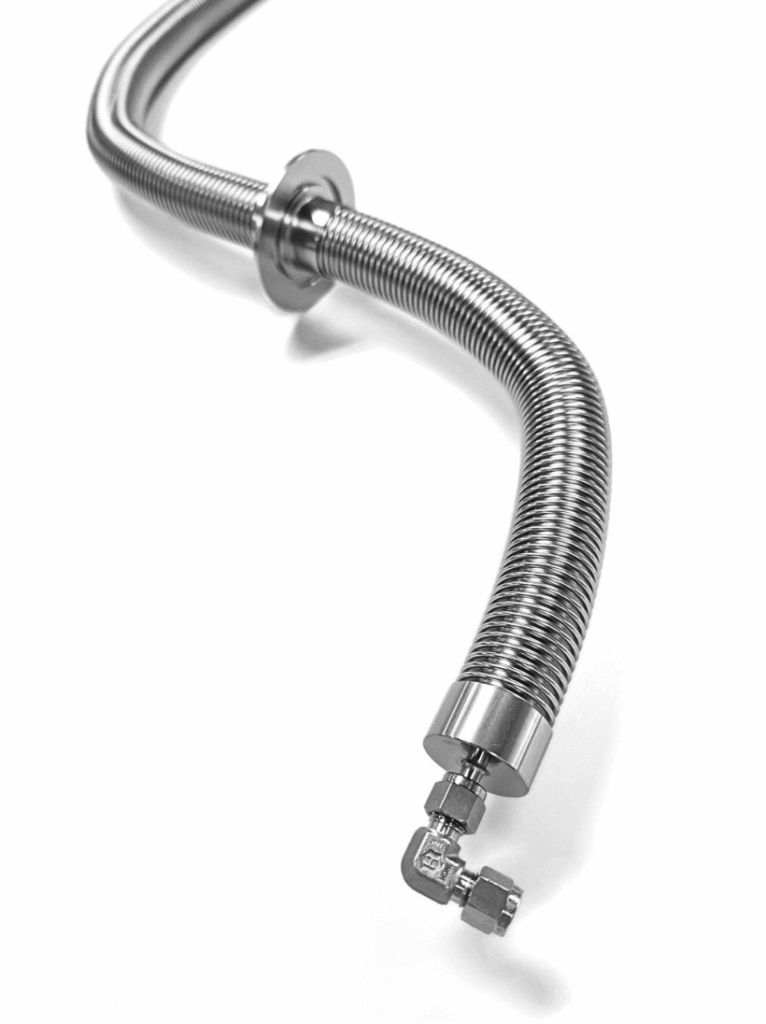
Continuous thermal insulation along the fluid path, from supply to in-vacuum delivery point
Insulon® Vacuum-Insulated Fluid Feedthroughs deliver continuous thermal insulation from the supply point, across the chamber wall, and to the in-vacuum delivery point. Equipped with a self-contained vacuum annulus spanning the entire vacuum jacketed hose assembly, Insulon® Feedthroughs route freely on both sides of the wall to eliminate the rigid constraints of conventional designs. This flexible construction enables high-precision thermal management for both low- and high-temperature fluids without the need for rigid tube bending.
1. Atmosphere-side hose run
Route fluid from the supply source to the chamber wall with minimal condensation, ice formation, and heat ingress on the atmospheric side.
2. Chamber-wall fitting
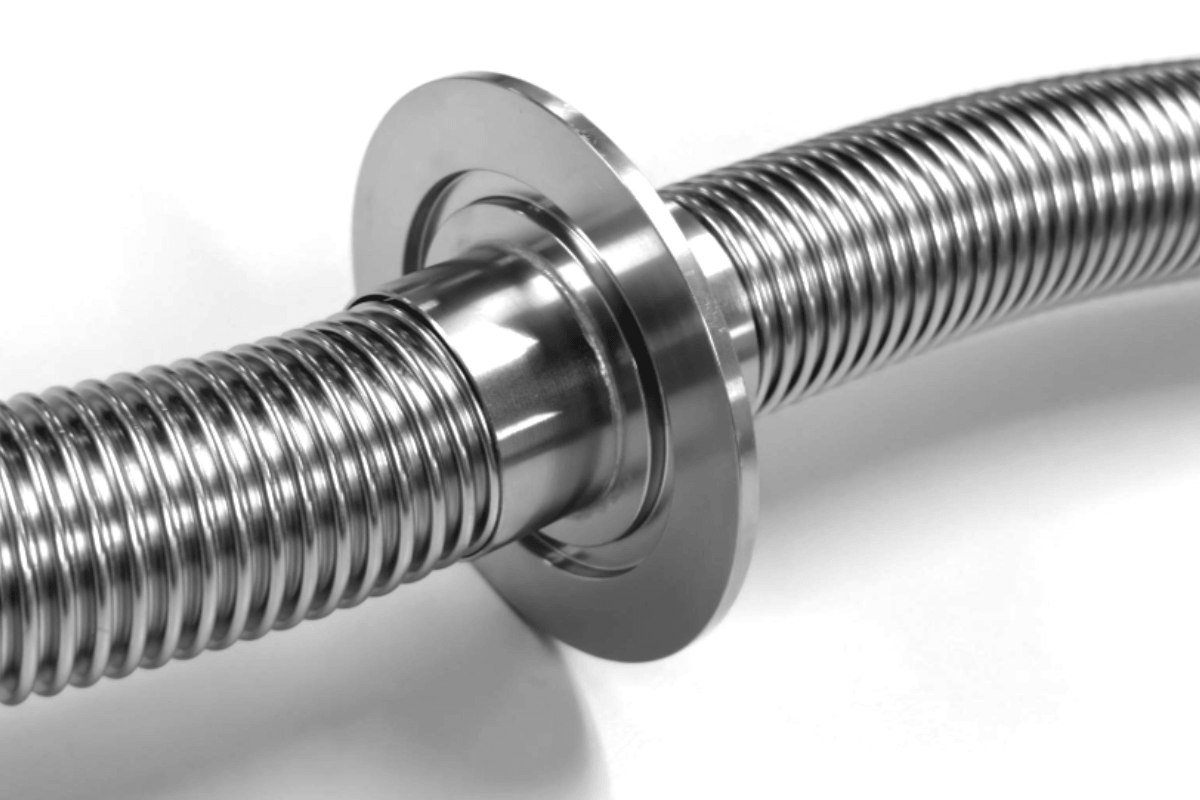
The vacuum-rated flange fitting (select from KF, CF, ISO, NPT, weldable, and custom configurations), mounts to the chamber wall and maintains both the chamber vacuum seal and the thermal insulation continuity of the hose assembly.
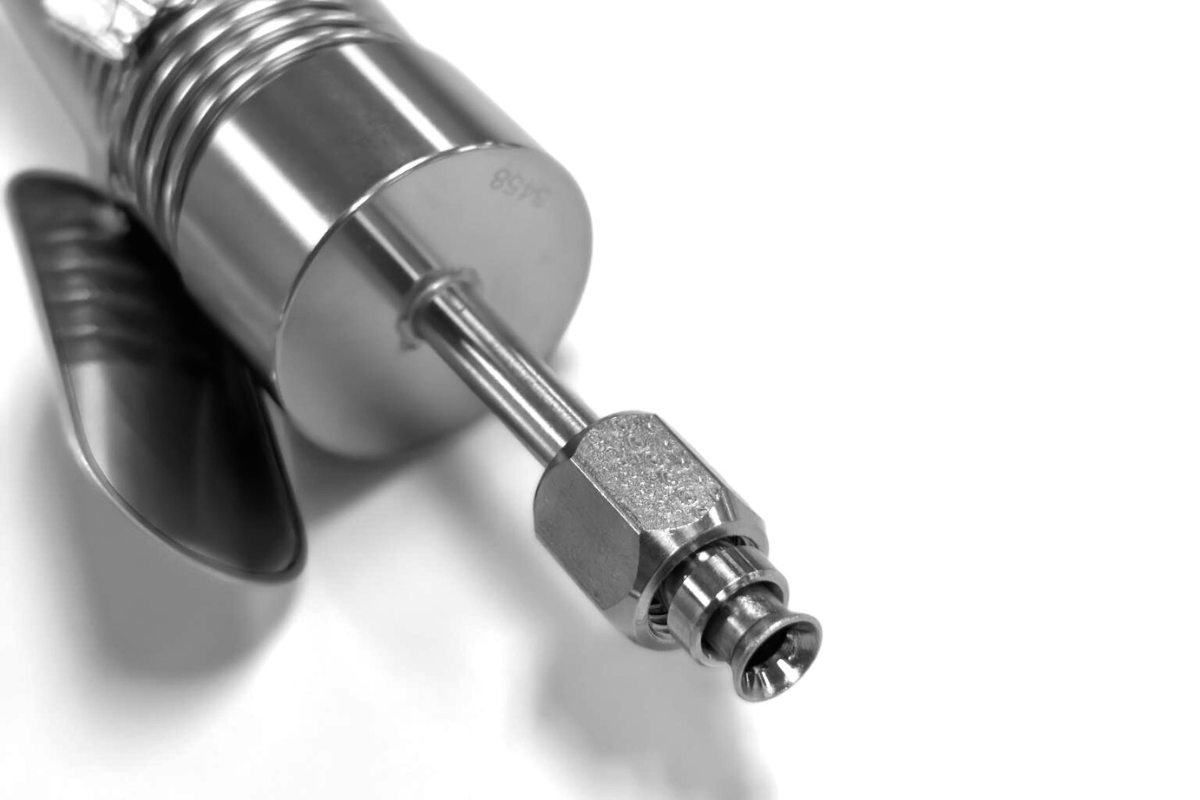
3. In-vacuum hose run
Inside the chamber, insulation continues to the delivery point. The sealed vacuum jacket suppresses radiant heat load from warm chamber walls, maintaining fluid temperature to the point of use.
Request a Quote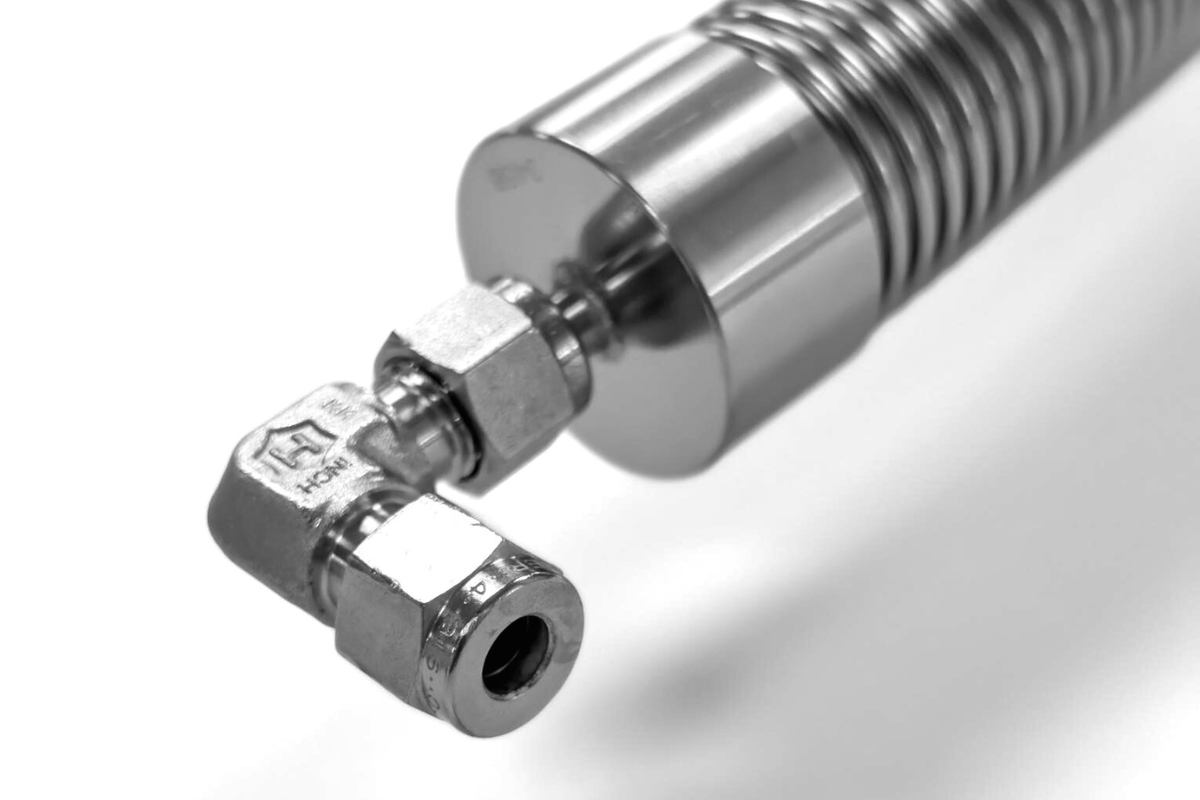
Engineered for the full fluid path
Every design decision addresses a limitation of conventional coaxial feedthrough technology. Insulon® Feedthroughs go beyond conventional solutions to deliver continuous thermal insulation from supply connection to in-vacuum endpoint.
Self-contained insulation
The vacuum annulus is sealed permanently at manufacture. Insulation performance does not depend on chamber vacuum level and does not degrade when the chamber is vented, cycled, or at atmosphere.
End-to-end coverage
Insulation runs continuously from the supply connection, through the chamber wall, to the in-vacuum delivery point. There are no uninsulated hose segments on either side of the wall.
Minimize condensation and icing
Vacuum insulation maintains the outer jacket surface near ambient temperature, within and without the vacuum environment, improving cleanliness by preventing condensation and ice build-up.
Flexible routing
The fully annealed corrugated Insulon® Fluid Feedthrough Hose routes freely in any direction, inside or outside the chamber. With no fixed geometry constraints, Insulon® Feedthroughs eliminate rigid tube bending.
Full flange compatibility
Available with KF (NW/QF), ConFlat (CF), ISO, NPT bulkhead, and custom configurations. Compatible with flange standards used across the vacuum industry, with additional mounting options available on request.
Wide temperature range
Insulon® vacuum insulation is engineered for fluids from -270 to 815°C. Suitable for liquid helium, liquid nitrogen, sub-ambient chilled fluids, ambient coolants, and high-temperature process fluids.
Insulon® Feedthroughs vs. conventional cryogenic feedthroughs
Standard dual-tube coaxial feedthroughs solve the wall-penetration problem. Insulon® Feedthroughs insulate the entire fluid path.
| Feature | Conventional coaxial feedthrough | Insulon® Fluid Feedthrough |
|---|---|---|
| Insulation at chamber wall | ✅ Coaxial vacuum gap (borrowed from chamber) | ✅ Sealed Insulon® vacuum annulus |
| Insulation on atmosphere-side hose | ❌ Not included; separate component required | ✅ Continuous, integral to assembly |
| Insulation on in-vacuum hose | ❌ Not included; bare tube exposed to radiant load | ✅ Continuous; suppresses radiant heat ingress |
| Depends on chamber vacuum for insulation | ❌ Yes, performance degrades when chamber is vented | ✅ No; sealed, independent vacuum annulus |
| Condensation / icing on air side | ⚠️ Risk present on hose runs outside chamber | ✅ Minimized; jacket surface near ambient temp |
| In-vacuum routing flexibility | ⚠️ Rigid tube; geometry fixed at installation | ✅ Flexible corrugated hose; routes freely |
| Maintenance vacuum required | ❌ Vacuum gap requires chamber to be pumped | ✅ No; sealed at manufacture, zero maintenance |
| High-temperature fluid capable | ⚠️ Some products rated to +300°C–+450°C | ✅ Yes, to +815°C |
Applications
If your application involves cryogenic or high-temperature fluid delivery into a vacuum chamber, Insulon® Fluid Feedthrough Hoses were designed for you. Insulon® Feedthroughs address three limitations of conventional feedthrough assemblies: uninsulated hose segments, insulation that depends on the chamber vacuum, and rigid in-vacuum tube routing.

Wafer chuck & cold stage cooling
For cryogenic fluid delivery to temperature-controlled substrates inside process chambers. Insulon® Feedthroughs eliminate condensation on the air side and maintain stable fluid delivery temperatures regardless of chamber vacuum state during process cycles.
- Process cooling
- Thermal chucks
- Cold traps

Thermal vacuum test chambers
For delivery of liquid or gaseous nitrogen for cold-soak testing inside large thermal vacuum chambers. Continuous insulation reduces fluid consumption and minimizes ice buildup that can contaminate the chamber environment or compromise test article surfaces.
- Environmental chambers
- Cryogenic simulators
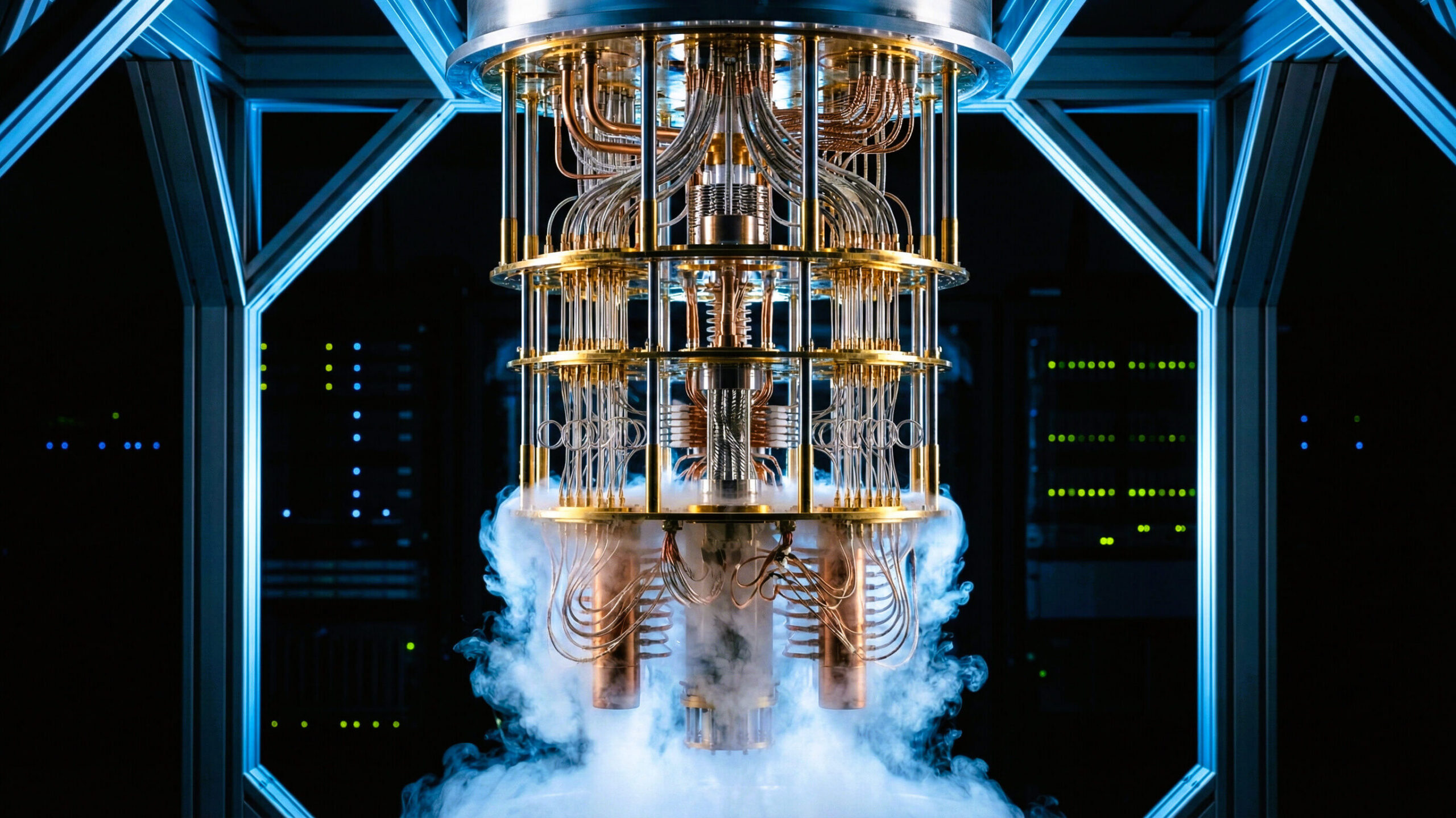
Cryostat and superconducting magnets
For liquid helium and nitrogen supply lines that penetrate the vacuum jacket of cryostats and dilution refrigerator systems. Insulon® Feedthroughs maintain thermal isolation at the ingress without relying on the cryostat vacuum for insulation.
- Physics labs
- Superconducting experiments
- Cryogenics R&D
PVD and CVD process cooling
For temperature-controlled fluid delivery to targets, substrate heaters, or magnetrons inside deposition chambers. Insulon® Feedthroughs maintain process fluid temperatures while minimizing minimize the amount of heat lost to the chamber environment.
- Deposition (PVD, CVD) with temperature-controlled substrates
Technical Specifications
THERMAL
| Operating temperature range | -270 to 815°C |
| Insulation method | Insulon® sealed vacuum |
| Vacuum compatibility | HV / UHV |
CONNECTIONS
| Hose end fittings | Compression fittings | Adapters | VCR | Flared swivel nuts | Flanges |
| Vacuum interface flange | KF | CF | ISO | Custom |
FLUID COMPATIBILITY
| Cryogens (LHe, LN2, LAr, etc.) | ✓ Compatible |
| Chilled water / glycol | ✓ Compatible |
| High temp. process fluids | ✓ Compatible |
MATERIALS
| Wetted surface | Fully annealed 316 stainless steel |
| Outer jacket | Fully annealed 316 stainless steel |
| Hose construction | Corrugated, flexible |
DIMENSIONS
Standard Performance
| Inner Diameter (ID) | Outer Diameter (OD) | MAWP (Low Pressure) | MAWP (High Pressure) | Min. Static bend radius |
|---|---|---|---|---|
| 1/4″ | 1.05″ | 72 psi @ RT | 750 psi @ RT | 3.98″ |
| 3/8″ | 1.05″ | 72 psi @ RT | 750 psi @ RT | 3.98″ |
| 1/2″ | 1.27″ | 72 psi @ RT | 750 psi @ RT | 5.00″ |
| 3/4″ | 1.62″ | 43 psi @ RT | 600 psi @ RT | 6.15″ |
| 1″ | 1.95″ | 43 psi @ RT | 500 psi @ RT | 7.62″ |
MLI Performance
| Inner Diameter (ID) | Outer Diameter (OD) | MAWP (Low Pressure) | MAWP (High Pressure) | Min. Static bend radius |
|---|---|---|---|---|
| 1/4″ | 1.27″ | 72 psi @ RT | 750 psi @ RT | 5.00″ |
| 3/8″ | 1.62″ | 72 psi @ RT | 750 psi @ RT | 6.15″ |
| 1/2″ | 1.62″ | 72 psi @ RT | 750 psi @ RT | 6.15″ |
| 3/4″ | 2.38″ | 43 psi @ RT | 600 psi @ RT | 9.41″ |
| 1″ | 2.38″ | 43 psi @ RT | 500 psi @ RT | 9.41″ |
Request a Quote
"*" indicates required fields