
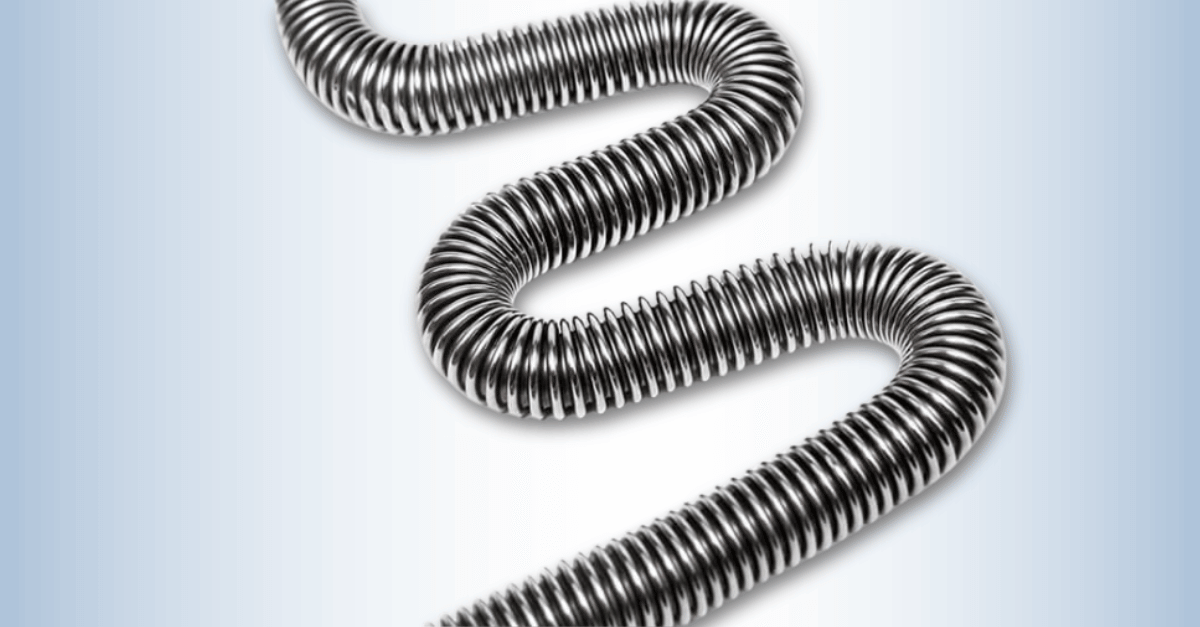
Hose product specification sheets usually list a pressure and a temperature range, and it is tempting to read the pressure as a single, constant value. However, pressure and temperature are interdependent variables. This means that the application temperature will influence the maximum working pressure of the hose. A stated pressure rating describes what a hose can do under reference conditions, but the real working pressure limit varies with application temperature.
For Insulon® Vacuum Jacketed Hoses in low temperature applications, including cold and cryogenic fluid transfer, determining the pressure rating is straightforward. The room temperature (RT) pressure rating listed in Insulon® Hose product specifications will be the same pressure rating applied to any applications below room temperature. For high temperature applications (above 38 degrees Celsius / 100 degrees Fahrenheit), be sure to have your maximum application temperature handy so that you can use it when referring to MAWP derating tables by temperature.
A rating indicates a class, not a constant
Most pressure ratings are class designations. For example, a pipe flange rated to ASME B16.5 Class 150 does not hold 150 psi everywhere; the class sets a strength tier, and the actual allowable pressure can be found in a pressure-temperature table for that material. The same Class 150 flange can lose a significant portion of its ambient rating at high temperature. Other flanges and end fittings work the same way. The pattern repeats for fluid transfer products including pipes, hoses, and tubing.
What MAWP means for vacuum jacketed hoses
Insulon® Vacuum Jacketed Hose is sold in two pressure classes, Low Pressure (LP) and High Pressure (HP), and follows the same logic. Each hose has a default Maximum Allowable Working Pressure (MAWP) which is stated at room temperature (RT) and applicable for all fluid transfer applications at room temperature and below, including cold and cryogenic applications.
For high temperature applications, MAWP specifications derate as application temperature increases. The higher the temperature, the more MAWP will be reduced. For example, at room temperature and below, Insulon® Vacuum Jacketed Hose, High Pressure, MLI, 1″ ID is rated to 500 psi MAWP. With a fluid temperature of 250 degrees Celsius, the same hose is rated to 385 psi MAWP.
Why pressure derates as temperature rises
The allowable stress a material can withstand goes down at higher temperatures and stays the same (or even gets stronger) at lower temperatures. Engineering specifications build this directly into their pressure-temperature tables, which is why a flange, a pressure vessel, and a vacuum jacketed hose are all rated at a reference temperature and then derated above it.
How to spec your system correctly
Use the hose inner diameter (ID) size, the maximum fluid temperature, and the maximum fluid pressure to determine whether Low Pressure (LP) or High Pressure (HP) Insulon® Vacuum Jacketed Hose is right for your system. If your application requires an even higher pressure rating than those available from HP Insulon® Hoses, contact us. We also manufacture and supply ultra-high-pressure Insulon® Hoses for applications with fluid pressures as high as 7000 psi.
View MAWP Derating Tables by Temperature for Insulon® Vacuum Jacketed Hose (LP & HP)
Contact us at [email protected] or +1 (561) 320-9995, or get in touch here.